A Blog about Finding Inspiration

"We have a wonderful world to be inspired by and each new day is like an adventure into the unknown, where things that require a second glance can be captured in time on a canvas for anyone to enjoy forever." (Louise Corke)

Friday, April 22, 2011

New pastel painting of Jeckell Island Marsh

11"x14" pastel of Jeckell Island Marsh.. The photo color  is more saturated than the actual painting.
 Last November I visited Jeckell Island.  I was very impressed with all the beautiful colors in the marsh.
Reference photo used to create the painting.
The pastel work area was set up so I could see both a value and a colored rendition of the reference.
I printed out the reference photo in color black and white to give me a understanding of the values in the scene.  I also displayed the photo on a monitor next to my easel. , then made a little test sheet of the colors/values  I wanted to use. Using my newly sorted values made painting the scene a snap.

Doing my homework

 My recent pastel workshop reinforced the importance of knowing the value range ot the stick of pastel I am working with.  So I set myself the task of grouping my collection of pastels by colors, and temperature, then sorting them again by value.

A photo of some mid tone sienna color chips against the gray scale. 
It's easy to do with the dark and light ends of the spectrum, but mid values get a little trick.  I wound up making a color chip of each pastel stick, then visually ranking the color chips, then  photographing the chips against a set of known value gray scale sheets.
I used photoshop to remove the color saturation so I could view it in gray tones
 A week later I have a well sorted set of  700  pastel sticks arranged and labeled  by  brand, #, color, and value. And I have a set of color chips with the same information just in case I loose the label and need to figure out where a stick of color belongs.
This is only a portion of  my set.

Greg Barnes Workshop

 I  recently attended a three day Greg Barnes pastel  workshop which was held at  the Island Art Gallery on Pawleys Island. The workshop opened as usual with introductions and a verbal review of the equipment that would be used. After which Greg gave us brief demonstration of his pastel painting technique.

The Demonstration on the first day was of painting from a reference photo.   Greg chose a traditional marsh scene from the photos he had brought with him, and proceeded to sketch the scene on his pastel paper with vine charcoal


Then he blocked in the dark tones often smudging the areas to blur and blend the tones.
 Next he put in the  mid tones followed by the lighter shades leaving these more distinct, especially near the focal point.
 Below you can compare the painting with the reference photo.  Obviously Greg is not into slavishly copying the original photo.
Greg then added in the highlights ,  intense tones , and details to finish the piece in less than two hours..

Day two was a lesson in plein air painting.  Actually all three days should have included some plein air work, but the weather didn't cooperate.  The morning of the second day was the only time it didn't pour.
 The subject of the painting was the Island Deli across the parking lot from the Gallery.  The bright red roof was eye catching in the morning sun against the stately old oak tree.
 Greg set up his easel in the parking lot outside the gallery and proceeded to sketch the scene in vine charcoal.

 Then Greg blocked in his colors.  Again he started with the dark tones of the oak, but quickly threw in some of the mid value red so as to have something to judge the other mid tones against.

This is a photo of the painting  when Greg ended the demonstration an hour and a half later.


On day three, it poured, so we were again stuck inside.  Greg decided to show us how to paint with a limited number of colors  

 using a background toned with watercolor .

 As promised, Greg pulled it off beautifully.   The trick, it seems, is in knowing your values well enough to pick the right set of limited colors.

 Each afternoon the class worked on their own paintings, while Greg coached us.  

 Every one's style was different.  From the semi abstract and dreamy painting above,

to the dark and moody one above. 

There were some highly realistic renditions,


and even an attempt to paint the same scene as Greg's original demo.(Below)
Clearly personal style matters.  Both paintings were beautifully rendered, but each was unique.

Monday, April 4, 2011

The Thunderhead 4 '11

With all the storms hitting the South, there has been a lot of dramatic cloud formations in the sky over the marsh....I just finished this pastel painting of a thunderhead I saw yesterday.

Oh by the way, so far, dramatic cloud formations are about the only action we have seen from those storm fronts.

Wednesday, February 16, 2011

On Making a Statement with Art 2 '11

Not the legacy I wish to leave


I just learned that the next meeting of one of my local art guilds will feature a critique session conducted by a well known local artist, 'whose claim to fame' is being socially controversial.   I had the misfortune of seeing this person critique  artists at another guild earlier this year. It seems he made his reputation looking for controversial social topics for his paintings.

In his opinion, if the art work wasn't  'edgy', and  shocking,  it wasn't worth viewing.

 I understand the reasoning from a marketing point of view. If my latest work is tagged on the internet with a controversial subject. label,  I am certain to get more hits from people interested in that topic.  Most of those viewer have little or no interest in my art, but the stat counters doesn't show that.  It only reports the number of people who have clicked on my web page.  The more clicks, the more popular and successful I appear to those who do not know better... but I do.  If I am truly  committed to a cause, then I am all for using my art as an instrument of change.  However painting controversial subjects just to make a buck is  not only boring . it is a waste of my talent and my viewers time..

Recently,  I ran across a blog post  from artist, Roger Bansemer ,who expressed my sentiments exactly.  He said:  "I have tired of looking at art that has been made convey social statements or to shock. There is altogether too much of it in the 24 hour a day news to entice me to spend much time looking at one more opinion. For myself, I need to look at something that takes me away from the upset and offer instead sense of permanency the world has existed in for so long without needing change. A mountain is as beautiful as it has always been. It doesn't need to update itself. I think we all need a rest from the shock. That's what I try and do with the paintings. I navigate to paintings without a message to offend, surprise, upset, or alarm. Paintings that give a respite from that is what I need."  Roger Bansemer 7/09/06

Thank you, Roger, for providing a moment of sanity.   More chaos thrust in our faces is not what what a shock weary world needs right now. A  reminder of the importance of beauty and serenity is.  You are truly a kindred spirit.

Tuesday, February 15, 2011

Brookgreen Waterlilies I

Spring is near and I am dreaming of flowers and warm days.
Original oil painting : " Brookgreens Waterlilies I"
I took a stroll  through Brookgreen Gardens last week.  Not much is in bloom yet, but the walk did inspire me to go back and review some of the photos I took there last Spring and summer.  The photos  I captured of  the waterlilies in the Alligator Fountain  brought back sweet memories of warm sunny days.  I  used the photo below as the basis for the painting above.

My  original reference photo of the waterlilies in Brookgreen's Alligator Fountain

Georgetown Lighthouse 2 '11

I  recently took a boat tour of South Carolina's Winyah Bay.  The tour included a visit to North Island and its  Georgetown Lighthouse.  I was so impressed with the history of the place that I decided to paint a picture of the lighthouse for my local landmark series. 
Georgetown Lighthouse 12"x9" oil
Her's my rendition of  the Georgetown Lighthouse.

and here's a photo  from the University of North Carolina of the  the lighthouse.

 By way of background....Georgetown Harbor, located in Wynyah Bay  between North and South Islands, is the second largest seaport in South Carolina.  Safe passage into the harbor is now, and as it always has been,  critical to the local economy.  In 1789, Revolutionary War Patriot Paul Trapier donated a tract of land on North Island for the establishment of the Georgetown Lighthouse.  (aka North Island Lighthouse.)  The seventy-two-foot, pyramidal tower, constructed of Cypress wood, was finished in the early part of 1801 Besides the tower, a two-story keeper’s dwelling was built along with a tank for holding the whale oil that fueled the lighthouse’s lamp. The wooden tower’s life was cut short by a violent storm in 1806.
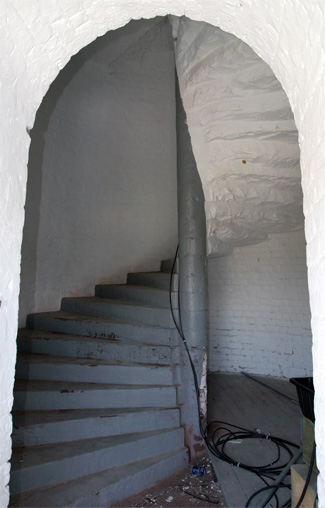
Several years passed before a replacement structure was built. A marble plaque positioned above the door records the names of those who undertook the work on the tower and records the year of its erection as 1811. This time the seventy-two-foot tower was constructed of brick, greatly reducing the chance that those big, bad gales which plague the area (aka hurricanes) would blow the lighthouse down. The staircase that spirals upwards inside the stout brick tower is made of stone. In 1857, the tower was modified to display a fourth-order Fresnel lens. 

When the Civil War broke out, the Confederates used the Georgetown Lighthouse as a lookout station, until Union forces captured it in May of 1862. The lighthouse was heavily damaged during the North-South conflict, and as part of the post-war repair work, the tower was heightened to eighty-seven feet.  The Georgetown Lighthouse was manned until 1986, when the Coast Guard automated the light.

As stipulated in the will of former Boston Red Sox owner Tom Yawkey, South Island and all of North Island, save the lighthouse acreage, was bequeathed to the South Carolina Heritage Trust, creating the Tom Yawkey Wildlife Preserve.  In 2001, the lighthouse property was added to the preserve.  This is a rare early federal lighthouse is listed on the National Register of Historic Places, and with it now under state control, the tower will hopefully be restored and one day open to the public.  The 1-story brick keeper's house, brick oilhouse (1890), and boathouse (1894) are also preserved