A Blog about Finding Inspiration

"We have a wonderful world to be inspired by and each new day is like an adventure into the unknown, where things that require a second glance can be captured in time on a canvas for anyone to enjoy forever." (Louise Corke)
Showing posts with label marshes. Show all posts

Friday, November 8, 2013

PAP-SE Wet Paint Show Opening 11"13

And the PAP-SE paints Charleston Marathon continues:
All week long we've been watching the nationally, and internationally known artist members of PAP-SE painting in on the streets  and surrounding marshes of  Charleston.
 
   This evening we got to see three  of the paintings produced by each of the artists at  the
Wet Paint Show Opening - Nov. 8 
While I had enjoyed watching the  artist's work in progress,  it was even better to get to talk with them without fear of interrupting their  concentration,
 and to see their beautiful artwork finished and framed.
 Their work will continue to be on display  until Nov 16th 
  at three adjacent  Charleston galleries:
Coco Vivo - 25 Broad Street,
 Galerie on Broad - 29 Broad Street
and Edward Dare - 31 Broad Street

Saturday, February 23, 2013

New Artwork at CAG 2 '13

I went to Charleston today with some new paintings for my wall space. I almost drown getting there in the torrential downpour we were having, but it was worth it. My  wall looks really nice with the wildlife paintings I did at Hobcaw Barony/Wynyah Bay, Huntington Beach SP, and Magnolia Gardens.

Saturday, December 15, 2012

Super tide at Pawleys Island 12 '12

 
   Flood warnings have been  posted all along the South Carolina coastline today  due to a super high tide. Far from wanting to flee the in-coming tide, Bruce and I rushed to the end of our street  to see what the high tide would do to Pawleys Island Marsh. In short, it turned it into a  gigantic mirror. With no place to go, many of the marsh birds huddled together on bits of debris like a still life stranded between an infinite sea and sky.  It was beautiful.  When I finally got around to reviewing the photos I had taken, I thought I had mistakenly set my camera on a black and white setting.  They were all nearly near monochromatic.  But no, it was just that I was so focused upon capturing the photo ops before me  that I failed to notice the lack of color in the scene.  I love how the gray-scale quality of the sky and water amplifies the stark nearly abstract design of the solid objects.

Monday, March 12, 2012

Jekyll Island GA 3 ' 2

You may remember from an earlier post in 2010 that we had stopped  overnight at Jekyll Island  while we were en-route to Florida.  We had been favorably impressed with what we saw then,  and had vowed to come back and spend more time exploring this Georgia State Park Sea Island. 
 One of the things we did not have time to see during our first pass through of the Island  was it's historic district. In 1886, Jekyll Island was purchased to become an exclusive winter retreat for America’s most elite families, known as the Jekyll Island Club. For more than half a century, the nation’s leading families, including the legendary Rockefellers, Morgans, and Pulitzers, came to Jekyll Island “to secure an escape.”  Many of their "cottages" are still here. 
Today, the Jekyll Island Museum tells their stories, giving an inside look at what life was like for both club members and their employees. 
 Offering exhibits, tours, and a museum store, the Jekyll Island Museum provides an introduction to the vibrant cottage life of the National Landmark Historic District and important landmarks beyond such as this colonial era tabby structure.
 or this Plantation Oak which is estimated to be the oldest Oak on Jekyll Island.
 While we did not take any of the formal tours, we did spend a significant amount of time riding our bicycles through the historic district homes and gardens 
  stopping to read all of the historical markers along the way.
The island has an extensive set of  well maintained bike trails  which allowed us to traverse the entire length and breadth of the island without the use of  a car .
Many of the bike paths are under the shade of the massive heritage oaks making it not just a  beautiful place to ride ones bike but a comfortable one as well

The bike paths not only go through out the historic district, but
 the harbor, 


the maritime forest, 
 The maritime forest

 the marsh 
  and  even through the dunes onto  the beach.   
 We were very impressed with the measures that the State of George has taken make such treasures accessible to the public, while protecting these same areas from use.  E.g. look at the viewing stations set up on the dunes so that people can watch the sunrise without trampling the fragile dune vegetation.  They are a perfect place to photograph or paint the seashore.
 All along the way there are bike racks for those that want to stop to explore an area of the island a bit more. We took full advantage of this , especially when it came to exploring the beaches.
We had seen the Boneyard Beach on our previous visit, but had not had time to fully explore it.
This time we were able to park our bikes 
 and walk completely around the north eastern leeward end of the island 
along the river
having a picnic along the way
then back across the marsh to where our bikes were parked

On a different day we explored the opposite end of the island checking out the river

and the small marina under the Talmadge Memorial Bridge


 Most early mornings were spent on the beach watching the sun rise
 and taking pictures of the beautiful dunes for a series of paintings CC is working on

 
Evenings were spent back in the historic district dining in one of their many fine restarants, 
 
  and walking their beautifully lighted gardens.
It's impossible to name which area of the Island CC enjoyed the most, but
I think it is fair to say that we will be back to visit Jekyll Island again some day

Monday, April 4, 2011

The Thunderhead 4 '11

With all the storms hitting the South, there has been a lot of dramatic cloud formations in the sky over the marsh....I just finished this pastel painting of a thunderhead I saw yesterday.

Oh by the way, so far, dramatic cloud formations are about the only action we have seen from those storm fronts.

Tuesday, February 15, 2011

Georgetown Lighthouse 2 '11

I  recently took a boat tour of South Carolina's Winyah Bay.  The tour included a visit to North Island and its  Georgetown Lighthouse.  I was so impressed with the history of the place that I decided to paint a picture of the lighthouse for my local landmark series. 
Georgetown Lighthouse 12"x9" oil
Her's my rendition of  the Georgetown Lighthouse.

and here's a photo  from the University of North Carolina of the  the lighthouse.

 By way of background....Georgetown Harbor, located in Wynyah Bay  between North and South Islands, is the second largest seaport in South Carolina.  Safe passage into the harbor is now, and as it always has been,  critical to the local economy.  In 1789, Revolutionary War Patriot Paul Trapier donated a tract of land on North Island for the establishment of the Georgetown Lighthouse.  (aka North Island Lighthouse.)  The seventy-two-foot, pyramidal tower, constructed of Cypress wood, was finished in the early part of 1801 Besides the tower, a two-story keeper’s dwelling was built along with a tank for holding the whale oil that fueled the lighthouse’s lamp. The wooden tower’s life was cut short by a violent storm in 1806.
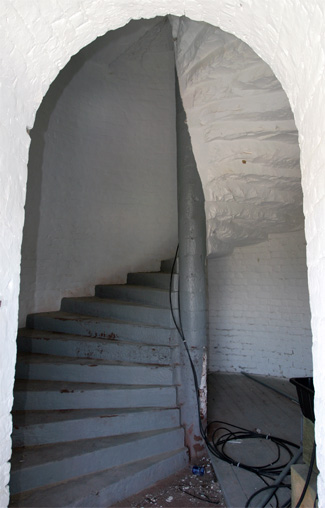
Several years passed before a replacement structure was built. A marble plaque positioned above the door records the names of those who undertook the work on the tower and records the year of its erection as 1811. This time the seventy-two-foot tower was constructed of brick, greatly reducing the chance that those big, bad gales which plague the area (aka hurricanes) would blow the lighthouse down. The staircase that spirals upwards inside the stout brick tower is made of stone. In 1857, the tower was modified to display a fourth-order Fresnel lens. 

When the Civil War broke out, the Confederates used the Georgetown Lighthouse as a lookout station, until Union forces captured it in May of 1862. The lighthouse was heavily damaged during the North-South conflict, and as part of the post-war repair work, the tower was heightened to eighty-seven feet.  The Georgetown Lighthouse was manned until 1986, when the Coast Guard automated the light.

As stipulated in the will of former Boston Red Sox owner Tom Yawkey, South Island and all of North Island, save the lighthouse acreage, was bequeathed to the South Carolina Heritage Trust, creating the Tom Yawkey Wildlife Preserve.  In 2001, the lighthouse property was added to the preserve.  This is a rare early federal lighthouse is listed on the National Register of Historic Places, and with it now under state control, the tower will hopefully be restored and one day open to the public.  The 1-story brick keeper's house, brick oilhouse (1890), and boathouse (1894) are also preserved

Thursday, September 2, 2010

Georgetown Rice Museum 's: Brushstrokes Exhibit 9 '10

The Rice Museum, known locally as The Town Clock, is located in the Old Market Building and is a prominent symbol of Georgetown County. Through dioramas, maps, artifacts and other exhibits, visitors to the Museum are enlightened to the history of a society dependent on the rice crop. In 1750, George Town became the center of rice production in the South Carolina colony. By 1840, the Georgetown District (later County) produced nearly one-half of the total rice crop of the United States. The 1850s proved to be the most profitable decade for the rice planters. The Rice Museum chronicles this most important American time line and its impact on not only South Carolina, but internationally as well.

The Prevost Museum Gallery is located next door to the Town Clock in the Kaminski Hardware Building. The upstairs museum contains maritime and colonial artifacts from the rice production era.  The downstairs gallery and  gift shop is filled with high end antiques and  locally made decorator items.  In addition the downstairs gallery walls regularly sponsor low-country art exhibits and judged art shows . It is a major center for art and culture in the community.

This month I entered an acrylic on watercolor paper scene of an egret into the Prevost Gallery's Brushstrokes Exhibit..  While it  and exhibit, not a judged show, there were some serious per-requisites for entry  I was pleased  just to be accepted into the exhibit.

Many of our friends and neighbors showed up for the reception
( above: Jim Sullivan and Noreen Sneed. Below: Noreen Sneed and the Blades)

My artwork drew a lot of positive comments during the receptions and I felt honored to be in such good company.

Sunday, May 9, 2010

Yawkey Wildlife Center tour and photo shoot. 5 '10

Sunday was a busy day.   Last week my friend Becky Sullivan (center above) called to say that she had arranged for a van tour of Yawkey Wildlife Center for herself and 12 other nature lovers.  Did I want to come?  Of course!

We were not allowed off the van on my last trip there .  I was told I could get off if I wanted to on this trip  so  I had hoped to get some good photos .
 
But the first time I stepped outside, I was swarmed by mosquitoes; after that I opted to stay inside the van.  (Above... lighthouse on North Island.)
 
Even so I did get some very good photos that I can use in my local landmark series.
 
Above is a picture of the second oldest AME church in Georgetown ( My collecting photos of churches for a series I am thinking of painting.)  And below is my favorite shot ... some purple pitcher plants in bloom.

Tuesday, April 13, 2010

Hobcaw Barony 4 '10

Hobcaw Barony  is a non-profit  wildlife refuge, aka Belle Baruch Foundation. Made as a royal land grant in 1718, it was eventually subdivided into 14 individual plantations. It became the winter residence of Wall Street millionaire and presidential adviser Bernard Baruch. Mr. Baruch's daughter, Belle, purchased all of the barony over a period of several years and at her death a foundation was created to use the land for the "purposes of teaching and/or research in forestry, marine biology, and the care and propagation of wildlife, flora and fauna" in the state of South Carolina.  The property , composed of low country  pine and maritime forest, and tidal marshlands, juts out into and is surrounded by the Atlantic Ocean, and Winyah Bay.  Access to the Barony's  17500 acres  is by guided tour only, and I have visited it several times  to kayak and bird-watch.  I wish the Foundation would sponsor a plein air painters or photographers day;  they don't, but I do have several great photos I've taken on the tours I have attended.
( Below photo of fire lookout tower) 
Given its immense acreage, and its geographical isolation, the marshlands here have a surreal quality about them.  The sky is huge  and other than the handful of people in my party there is almost no evidence of human. I always feel small.  It feels comforting to be reminded that nature has her own agenda and in many ways it is much more sublime than the plans of man.   I tried to capture that emotion this week with a couple of paintings of  the marsh at Hobcaw.  I included a human element in both just to give perspective to the scene, but in both cases, I tried to emphasize the grandeur of the place with its immense skies and endless empty horizons.
 Below:  Boat landing

Tuesday, March 30, 2010

Pawleys Island and Prince George 3 '10

It had been raining hard for two days when there was a sudden break in the clouds yesterday.  Ie rushed down to Pawleys Island to catch some rays and much needed fresh air.  It was low tide, so the entire southern tip of the island was exposed.  Only the narrow neck of the inlet, between Pawley's and Prince George, was underwater.
Both the clouds above, and the reflections below were magnificent.  You can be sure that some of the photos I took will become the basis for some of my local landmark series.   Shortly after the photos above were taken the sky grew dark with ominous thunderheads.  I barely made it home before the deluge resumed.

Monday, February 8, 2010

Yawkey Wildlife Center March 2 '10

Several Artists had told me about what incredible photo ops the Yawkey Wildlife Center  on Cat Island offered  for artists who wanted to get some reference photos of  primitive barrier islands around the Winyah Bay. I decided to follow through with a call to their visitor information center, and soon found myself on a guided tour .
Invited tour guests are asked to meet at a dock on the banks of the Intercoastal .  The wait provides an interesting place to all of the large ships traversing the waters in an out of the Georgetown Harbor.
  I hadn't realized there was that much large shipping on the Inter-coastal.Waterway.
Eventually a small boat arrived at the dock to taxi us across to the Island.
Once on Cat Island, we were introduced to our Tour Guide and 
loaded into vans.
The tour began immediately as our guide began to explain the various ecosystems and subsystems we were passing through..  Much of it was forested land, but there were also a lot of early colonial archeological sites along the way.
Like this grave-site  of the Hume family (above)
or the rice chimney below
I had hoped to get some really good photographs on this trip. The guide did not have a problem letting us out of the van, but warned us that even this early i the year, the insects were voracious.
He was right.  I took the photo below then decided that discretion was the better part of valor.
The remainder of my pictures were taken from the within the insect proof van.

 We drove down the dikes that separated the former rice fields while the guide explained  what life was like for slave and master alike on a rice plantation.

  He also explained how  dam projects on the Santee River had reduced the out flow of fresh water allowing more sea water to come in with the tides and salinating the soil so it was no longer arable for crops. Today the fields are seeded to help act as a sanctuary for migrating birds.
and the canals act as protected havens for some of the largest alligators in South Carolina.
Everywhere  we saw evidence of a healthy ecosystem where the nature had begun to reclaim the land and wildlife was flourishing


As a final stop we drove to the point on the island where we could look across Winyah Bay at the  Lighthouse on North Island.
I was disappointed that I hadn't been able to get better pictures, but I gain an immense appreciation for the place. I did take a lot of photos, and I am sure some of them will serve me well for jogging my memory of the place. should I wish to paint it.